Friday, February 18, 2011

Semana Seis


This week was certainly exciting and exhausting, ¡todo al mismo tiempo! The week started off splendidly; we had a nice group gathering at one of the houses to celebrate día de amor y Amistad, as well as Anna’s 21 birthday. This week was also our final week at Solexico, which wrapped up nicely with oral presentations of various topics. We will certainly miss Solexico, but are very excited to move onto the second part of the program. Can’t believe it’s here already!

Tuesday we got our first taste of Mexican Politics. President Calderón came to Oaxaca on Tuesday to sign a bill that subsidized private schools in Oaxaca. Recently, a movement was passed that would provide tax cuts to those who sent their children to the private sector. Public school teachers were clearly not too happy with this, and planned a demonstration to express their criticism. Tensions got a little high in the Zocalo, but all is well now. It was hard to avoid the growing crowds in the streets of the city. Don’t worry mom and dad!
((A seemingly endless stream of teachers marched through the city))

With a lot of work and everything from the first half of the program wrapping up, it was a quiet week. On Thursday we enjoyed a very pleasant tour through the botanical garden near Santo Domingo, lead by the wife of Ron Waterbury.
To up the gringo-factor, we were given awesome straw hats to wear on our tour (as you can see, everyone looked really good).

We were all very impressed with the tranquility of the garden, set in the middle of the city. We toured through the section of edible plants and learned why chilis are so picante (spicy). One of our favorite plants was the Pochote tree, which is considered sacred by many indigenous groups of México. The tree has dinosaur-like spikes, and it's branches grow perpendicular to the trunk, creating a very interesting appearance.
((The Pochote Tree))

We learned about the difference between Mezcal and Tequila, although the process is the same. We saw some truly beautiful flowers and vegetation, and enjoyed a great afternoon together.

((The beautiful Oaxaca, by night))

We have a long weekend ahead of us, with many exciting plans to do “research” at the beach and other places! ¡Vamos a la playa ahora, hasta la próxima semana!

Yours truly, Danielle y Rachel

Sunday, February 13, 2011

Semana Cinco

Hola familias y amigos!

Well, it’s official: we have been in Oaxaca for over a month! We have thoroughly enjoyed our first month in Oaxaca, and we are all excited for what is in store ahead. As usual, this past week was filled with Spanish classes at Soléxico. This week we conducted interviews with local Oaxacans for class. It was a great opportunity to converse with locals here in Oaxaca and learn more about their culture and views.

In our Community, Culture and Change class we discussed the market system and how it functions in Oaxaca. Ron Waterbury is an expert in this field, and provided us with an abundance of information on the topic. We learned that most of the products grown in Oaxaca are also consumed within the country. Ron also spoke about Market Place Peace, which allows isolated communities to function well economically, despite any problems villages might have between each other. This system permits communities in Oaxaca to have their own individual markets and remain relatively autonomous. We visit markets frequently here in Oaxaca, and most of us purchase our food from several markets within the city, so it was fascinating to learn about how these markets function and their role in the community.

On Tuesday in our Radical Pluralism class with Gustavo Esteva, we had a heated discussion regarding health and healing. We talk about the concept of health and its meaning within the United States. We also discussed Wendell Berry’s concept of health, and learned that the word “health” comes from the same root as “heal,” “whole,” and “holy.” To Berry, to be healthy is literally to be whole. This idea was discussed further in our class, and we had a very engaging conversation on the topic.

On Thursday we took a trip to San Antonino del Valle with Ron Waterbury. Our first stop was to visit to Radio Calenda, a local community radio station. Here we met with one of the station managers. Radio Calenda gives a direct voice to the people of Oaxaca. The station is not paid or funded by the local government, and for this reason, those who voice their opinion on the radio have a true freedom of speech. There are over 100 local community radio stations operating in the state of Oaxaca.


Our second stop was to the San Antonino city council, where we were fortunate enough to speak with the municipal president, who was the first elected woman for the position. We also spoke with several of the other council members. We learned about the problems that need to be addressed in the municipality, such as water scarcity and system problems, issues with the education system, the preservation of the indigenous Zapotec language and culture, and woman’s rights and equality. It seems as though this council is truly working for the benefit of the people in the municipality.


To no surprise, it was another eventful and fun-filled week here in Oaxaca. We are all looking forward to our last week of Spanish class and moving on to our different tracks of food systems, geology and music, and advanced Spanish.

Hasta luego!

Becky C. y Jocelyn

Monday, February 7, 2011

Week 4: Food &Hunger, Migration, Weaving
and Sta. Ana del Valle

¡Hola! It’s been another busy week in sunny Oaxaca for the gringos from Vermont. Once again, the mercury hit 80F every day and clouds rarely got in the way of the all-powerful Oaxacan sun. We continued with our third week of Español classs at Soléxico. It’s hard to believe that we only have two more weeks left there. How time has flown! On Monday Ron Waterbuy, our professor for Culture Community and Change, talked to us about peasant economics in Oaxaca. We learned about how their society is structured and how each household is a production and consumption unit. This is much different that the capitalist system, where production is highly specialized and not owned by the consumer. Once again, we were presented with a way of living that is vastly different than the way we know.

Migration

Later in the week Jack Corbett, a professor at Portland State University, lectured us about migration in Mexico. One striking aspect of the conversation was questioning why people migrate. In most cases Mexicans don’t want to migrate to the United States to enjoy our way of life, but there are few jobs in their communities of origin. Often times, it is U.S. economic policy that causes such dire economic situations. When the U.S. sells cheap corn (subsidized by taxpayers) on the Mexican market, it puts Mexican farmers out of work. Migration can have devastating effects on communities, where some have lost more than half of their populations. The issue is especially prevalent in Oaxaca, which is one of the poorest Mexican states. In Oaxaca, one of every seven pesos in circulation comes from remittances sent from the U.S.


Food

Class with Gustavo this week centered on the topic of food, and more specifically, food scarcity. The question he presented to guide our conversation was “In spite of the highest agricultural yields in the history of the world, why are there still so many hungry people?” No doubt a loaded question, but we grabbed the bull by the horns and proceeded to have an extremely animated conversation. We began by exploring the rise of commodity-based agriculture during the Green Revolution, a system based on mechanization, specialization and the heavy use of petroleum-derived chemical inputs. We then explored the role that foreign aid has played in the spread of green revolution agriculture throughout the world and the effects, positive and negative, this system of food production has had on the global food system.

The conversation then transitioned to a more philosophical realm. We discussed the topic of food sovereignty and we were presented with the idea that our diets should not be defined by an economic system but rather by the needs of our bodies. For example, we explored the sensibility of the US consumption of meat. Close to 50% of the grain grown in the US is fed to animals and it takes 8 grams of grain protein to produce 1 gram of beef protein. This is an extremely inefficient system, yet it the dominant one in our country because it is very economically profitable.

We also explored the complicated topic of ethanol production for use in automobiles. Our government praises ethanol due to its ability to strengthen our economy and lessen our reliance on foreign oil. They don’t however publicize the fact it takes more fossil fuel energy to produce the same amount of energy in the form of ethanol. We learned that about 40% of the corn grown in the U.S. is used to produce ethanol. So essentially we are growing food, and instead of eating it, are feeding it to cars through a process that uses more energy than it produces.

While the microphone was held for the most part by the food systems students, at the end of class, everyone expressed that they had learned quite a bit.

Santa Ana del Valle

Friday was the day of our overnight trip to the Zapotec pueblo of Santa Ana del Valle, and after an exhausting and mentally challenging week of classes, we couldn’t wait to get out of the city for a night. Santa Ana is set at the base of the mountains, about 45 minutes southeast of Oaxaca in the central valley. The most common occupation of its residents is rug weaving, and it accounts for around 98% of the village economy.

The main purpose of the excursion was to learn more about the effects that migration has on communities, and Santa Ana was a perfect case study for this. The official population of the village is listed at around 4,000; however, at any point in the time the actual number of people residing within the village boundaries is closer to 2,000. This is due entirely to emigration to the United States.

Upon arrival we split up into our home stay groups and went to our respective homes for comida. After a delicious meal we returned to the town center for a tour of the village museum that was created in the mid-eighties, and has become a model for other pueblos throughout the Americas interested in preserving their history. Next, we traveled through the hard packed dirt roads until we reached one of the many weaving cooperatives that exist in Santa Ana. There we were witness to the incredibly labor intensive process of creating hand woven, naturally dyed rugs. They showed us how they produce all of the yarn and dyes completely from scratch. The amount of work that is put into each rug is truly inconceivable without seeing it first hand.

The next day we found ourselves at the home of the village healer, an elderly women who had been practicing her form of medicine for 25 years. We learned how she diagnoses illnesses (it involves rubbing an egg on the patients body and then cracking it and examining the yolk), her different treatment methods and she even performed a healing ceremony on two of us! It was quite an eye-opening experience.


Kristof brushing (straightening) the wool to be wound

Max spinning the wool

Steph crushing cochineal bugs to make a natural red dye from cochineal (one of the many traditional dyes derived from plants)


Dying the wool
Working the loom
Tapetes
The village healer cleansing Tessa and Anna to remove bad energies while burning copal (a sacred type of tree)


We are all gearing up for another fun-filled, knowledge loaded and spiritually enlightening week of classes! - Kristof and Jake

Sunday, January 30, 2011

Semana tres !


Hola familias y amigos desde Oaxaca! This week started out as usual with Spanish classes at Solexico from 9-12. We were lucky enough to have Manuel Esparza come talk to our anthropology class about the role of the Catholic Church in the history of Oaxaca. In our Radical Pluralism class and our Experiencing Oaxaca class we worked on brainstorming for our autonomous study projects which will be completed independently throughout the semester. Everyone in the group is very excited for the academic freedom of the project and that it gives us time and allows us to explore a topic we are passionate about within the culture of Oaxaca.

Cuties eating comida (sopa, pollo con mole y cactus con arroz
Thursday and Friday were pretty juicy with back to back extravaganzas headed by Ron Waterbury, Mary Lucia and Sergio Beltran. On Thursday after Solexico and a scrumptious lunch out we headed to Insitiuto de la Naturaleza y la Sociedad de Oaxaca (INSO) where proposed efforts and solutions of the current water crisis here were explained to us. Then we drove about 45 minutes out of the city to San Andrés de Huayápam to a permaculture center. Here they are demonstrating how to convert Oaxaca's current use of fast water back into a slow sustainable usage. This has created a reabsorption back into the earth which has been reversed by the vast amounts of cement use and the erosion impact due to intense rainy season after a scorchingly hot dry season. Through INSO's information we began to rethink water not as a commodity, but instead as a precious item and as something that should be respected and valued. We learned INSO also has programs devoted to community nurseries, energy efficient stoves, and local food production.

Finally Friday came and our day started by visiting the town of Santo Tomas Jaleiza known for its beautiful weaving and textiles.Next we drove onto the cattle market or in Spanish Baratillo de Ganado, where every Friday members of the community buy and sell livestock. Although we felt a little out of place among the giant cows it was amazing to witness the relationship between the granjeros and their animals. Onto our next stop, Mercado de Ocotlan which takes place every Friday. The state of Oaxaca is special because every day of the week there is one major market in a different location where vendors come to sell produce, meats, cheeses, clothing, leather, pastries, ect.. We were blown away by the piles of oranges, mangos and avocados and many other tropical fruits we had never experienced before. After lunch we ventured to San Martin Tilcajate which is the town famous for alebrijes which are carved wooden animals that are then painted. The paints used are natural and come from the resin of certain trees mixed with lime(calcium carbonate), lemon juice, honey, and pomegranate rind to make various color variations. The detail of the painting is truly remarkable and most of us purchased a small animal to represent our birth date.

Oaxaca is a dream! We are loving the sunny and clear skies and mountainous landscape. The people and the culture are one and the food is changing our perception of what fresh and local really means. We love aguacates.

Peace Love and Oaxaca,
Livy and Zoe

Sunday, January 23, 2011

Second Week

¡Hola! With our first week of school under our belts we are all starting to get into the swing of things, establishing our routines and really becoming closer as a group. After having our Spanish classes Monday through Friday from 9-12 last week we can confidently say that everyone is learning so much. Breakfast and Comida with our host families is also helping us to learn even more Spanish because they don’t speak English with us. We are also enjoying our classes with Ron Waterberry and Gustavo Esteva in the afternoons. Last week on Wednesday some of us took a cooking class after Spanish class and we learned how to make Guacamole. It was delicious!


(courtesy of Katie Pearce)

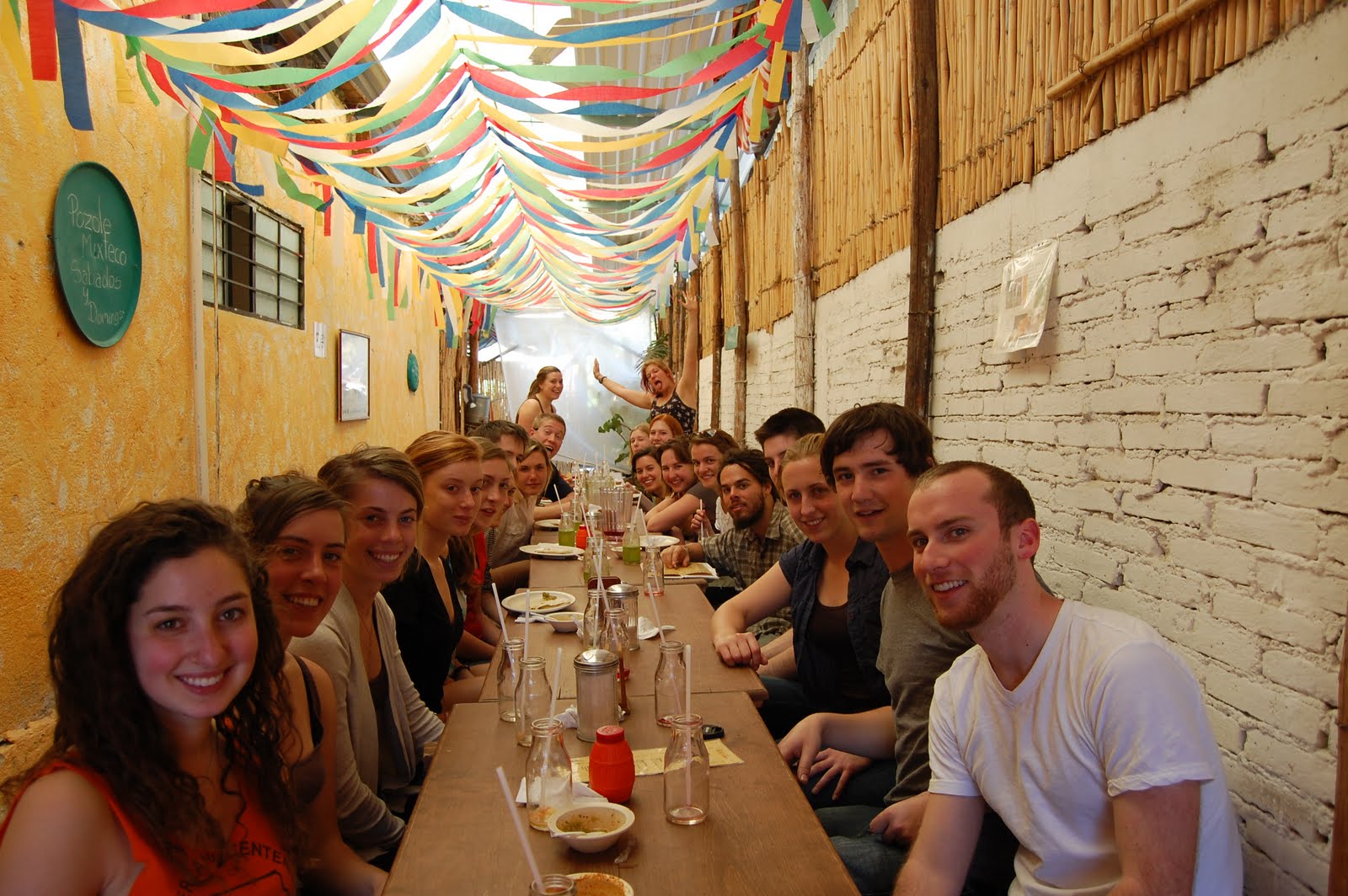
On Thursday we went out for Comida (lunch) as a group with Mary. We went to a small authentic restaurant called Itanoni (http://www.itanoni.com.mx/). It was so good! All the food was cooked on Comals, which are disks made out of pottery used for cooking tortillas that were actually invented in Oaxaca by the Zapotecs. To no surprise the food was amazing, especially the Tetelas de hongos, (tortillas filled with mushrooms and cheese)


On Saturday some of us ventured off to the local indoor market, they had everything you could have ever imagined in terms of food, and even something you wished you hadn’t seen haha. Then later that night we all went out to eat on the rooftop of Mesa Luna to celebrates Steph’s 21 birthday.

¡qué les vaya bien!

Mike y Rob

Sunday, January 16, 2011

Bienvenidos a Oaxaca! 1/16/2011


Hola amigos y familia! Well, we made it and are all settled in with our homestays. Mexico has been incredible so far, to say the least! We've been busy basking in the sunshine, eating the most delicious food we've yet to encounter on planet Earth, and acquainting ourselves with the culture around us. Our first morning commenced with breakfast at Casa Arnel, and then we were whisked away to San Lorenzo Cacaotepec for a week long retreat at an old Hacienda called "El Encuentro" (The Encounter).


Here we were all able to get to know each other, as well as some of our professors for the semester. We played some group bonding games with Sergio and learned about Oaxacan history and culture from Gustavo. There was also a lot of free time where we would take walks down the quiet, dusty roads to the local village, passing ruins, donkeys and countless stray dogs, as well as residents with who we were able to practice our Spanish.


On Friday we visited Monte Alban, the remains of where over half a million Indigenous lived at one point. We also had time to explore the city of Oaxaca that afternoon before heading back to our last night in the remote San Lorenzo.


On Saturday, we were introduced to our new families and homes for the next few months--all of whom provided warm welcomes. Now it's time to get focused with 9am Spanish classes down at Solexico and afternoon classes with our UVM professors.

Hasta luego!
Heidi y Erin